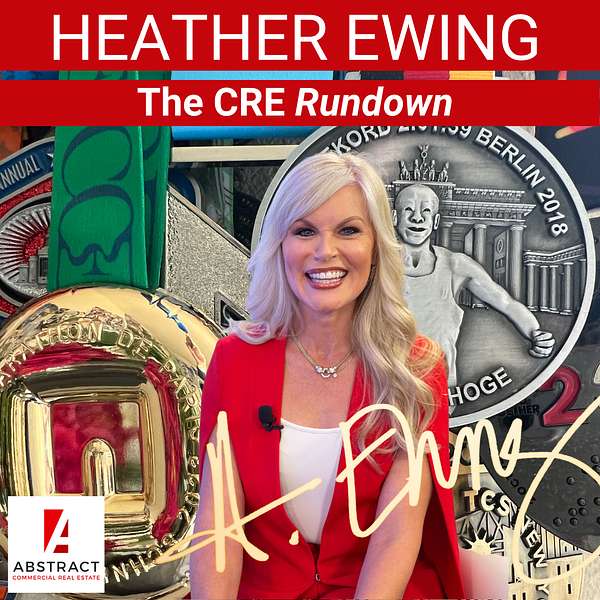
HEATHER EWING: The CRE RUNdown
Are you intrigued by Commercial Real Estate? Join Heather Ewing, CCIM each week as she dives into CRE trends, Deals, and Developments throughout Madison, WI. Learn the crucial role of Mindset in CRE and Marathons! Success leaves Clues.
HEATHER EWING: The CRE RUNdown
Ep. 73 How Danny Gould Navigates Market Cycles and Builds Investor Confidence
Welcome to Heather Ewing, the CRE rundown. I am your host, Heather Ewing, and today we've got a great guest. As usual, it is none other than Danny Gould, and he is the owner of Gould Capital. Danny, welcome.
Danny Gould:Thanks for having me on, Heather. This is uh this is gonna be fun.
Heather Ewing:Definitely. So we've known each other uh for a little bit through LinkedIn. I love your new podcast and seeing those go out. You always have a lot of great content, which I appreciate. Share with our group here. Yeah, share with our audience a little bit more about you.
Danny Gould:Uh sure. So Gold Capital is a boutique investment office. We uh have two verticals. We the first vertical is a fund-of-funds model. We have retail investors that have been in my network now for some time. We uh typically source deals across the CRE spectrum to make an LP allocation towards uh right now we're looking at like once a quarter, do uh one to two million dollar SPV. And um we raise retail capital via our fund-to-funds model to make LP placements into um into great commercial real estate projects. So you can think of me as a middleman, uh a guy who who really has a passion for commercial real estate, has access to deals, and I give my retail investors, investors in my ecosystem, access to those deals via my fund of funds. And so that's our first vertical. Our second vertical is for sponsors who have larger projects, right? So typically I find fund of funds is is great for smaller projects, call it like five to ten million dollar range. Uh uh once we get to the $10 million plus range, our $1 to $2 million checks become less and less meaningful. And so um I spent uh many years as, or several years, I should say, as a co-managing partner of a small hotel portfolio and in that time built a lot of institutional capital uh relationships. So what I uh what I do is I help sponsors source institutional capital for their projects. If uh typically we look for projects that have equity mandates in the five to ten million dollar plus range, and we will pair sponsors with institutional capital partners that fit their that fit their project type. So, you know, obviously there's a wide array of commercial real estate projects out there from ground up to core plus to value add. And so we have institutional capital partners that uh have different differing mandates and and different projects or different different uh investors will be right for different projects. So those are really the two verticals that we have here at Google Capital. And um, yeah, it's it's an exciting time to be in the space.
Heather Ewing:Definitely. So backing up a little bit, retail, right? Obviously, we know retail restaurants is near and dear to my heart. What made you decide to focus on retail?
Danny Gould:Oh, well, maybe you mistook me. So I when I say retail investors, I mean uh investors uh like me and you, everyday people who are looking to invest into uh into commercial real estate projects. So when I when I say retail capital, I'm specifically referring to uh Heather, uh everyday people. And so there's a the difference between retail capital and institutional capital is that retail capital is gonna be individuals, and typically institutional capital will be uh larger funds, family offices, multifamily offices, uh pensions, endowments, uh insurance insurance, that that sort of thing, right? So so those that's the difference. Uh when I say retail capital, and it's an easy mistake to make. Uh I simply mean individual investors, accredited investors. Okay, yeah.
Heather Ewing:I'm used to institutional, but see, that's the beauty. We can learn for the retail.
Danny Gould:Yeah. Yeah. And different people call it different things. So some people call it accredited investors, uh, some people say retail. Right. Exactly.
Heather Ewing:Exactly. Yeah, definitely. But so what do you find most challenging, right? You hear so much about the markets up and down, this, that, and the other thing, which the way I see it is it's always going to be there, right?
Danny Gould:Yeah.
Heather Ewing:How do you navigate through that for some of your investor clients so that they're not, you know, really getting tipped up and down and thrown around despite the market?
Danny Gould:I think as a professional, your job is to be a calming force because you understand the complexities of the market that you are an expert in, and a lot of average investors will only pay attention to what's fed to them by the media, and usually the media and the news is geared towards feeding negativity, right? And so negativity sells, positivity doesn't, and that's just a sad reality of the human existence. But us as professionals, our job is to assess the current atmosphere, the current climate, and be able to provide reassurance when appropriate. And then, you know, when appropriate, we are the ones that can steer clear of the danger zones. So that's our responsibility.
Heather Ewing:Definitely. And speaking of responsibility, how do you see, you know, it's it's the buzzword and it's being talked about, but AI, how do you see that helping and also hindering commercial real estate investing?
Danny Gould:Uh well, I mean, look, I I will be the first to admit I use AI almost every single day in my current business. I have trained several AI models to scrape offering memorandums. I've trained uh AI models to scrape underwriting um underwriting models. So these are tools that can help us uh work faster, right? And and and sometimes help us decipher things that may not be necessarily um a hundred percent clear. You know, sometimes I mean it's crazy, like even in the commercial real estate world, just like our misunderstanding just uh a second ago, retail versus accredited. Okay, so how many times have you penned through an offering memorandum and there's like a word you're like, I've never what are they talking about? And then you know, you can feed it to an AI model and you're like, oh, that's what they like you put two and two together because different people use different terminology. It's uh it's like football, right? You uh you hear all the time where uh quarterback goes into a new system and they got to learn the system because even though it's the same sport, they're using different terminology. And so, you know, that's that's another example of like you know, being able to use AI because AI knows every like it really understands a lot more uh than uh that we probably even give give it credit for right now. So uh you know those are those are two concrete examples. I think for the everyday investor, uh they're uh AI can help, but I've also seen it hurt in some ways. Uh let me like give you an example. You know, there sometimes people can overuse AI and and so like they can maybe come up with a they'll they'll they'll take an OM. I I've I I know a couple of accredited investors uh who have done this where they'll take an OM and they'll basically ask Chat GPT to like poke as many holes into it as possible, and like and I'll get a laundry list of like 30 questions from the investor, and it's so obvious that all those questions were generated by AI. I'm like, dude, right, like this is hilarious, right? So um so I I think that sometimes people can overuse it or use it in a way where it's allowing the AI to do the thinking for them. And so I what I find the AI to be most useful for is extrapolating data um and then you know parsing through data and then allow I'm still the one that's the brain behind the decision making, uh not allowing the AI to make decisions for me. I think that's where people get into a lot of trouble.
Heather Ewing:Oh, definitely. I mean, if you think about it, it would be like having a really smart intern suddenly take over, where they might be really solid at analyzing numbers, but they do not have the business acumen, the experiment, experience, and deal knowledge to be able to handle those really important nuances that make or break things. So, and kind of like yourself, our names are both tied, right? Of we are both our brands of our businesses. And I think being boutique also, people know that they're getting that higher level of service because we are touching those numbers and making sure that things are accurate. And that's where here in in Madison, I like to sometimes different deal terms. I like to see what Chat GPT says different deal rates are and things like that, right? Because there's errors in that. And I just got an offer the other day from a guy, and yeah, I was like, Oh, did you create this on Chat GPT?
Danny Gould:Yeah, yeah, yeah.
Heather Ewing:And then later, yeah, and it's like, yeah, you you can tell. I've never seen one like this.
Danny Gould:Yeah, it's pretty easy to tell.
Heather Ewing:Yeah, exactly. So as we take a step back, right? Investing, it's busy, it's wild, it's crazy, it's fun. How do you de-stress?
Danny Gould:Uh well, I I I'm an avid CrossFitter, and um, I usually I I usually work out twice a day. Um, so I usually do a morning and an evening workout um six days a week. What's your recovery for that? Um sleep, but not a lot. So that's pretty much it, you know.
Heather Ewing:Come on, Danny. You gotta you can't burn it at both ends. That's a lot.
Danny Gould:Yeah, I know, I know. I'm a glutton for punishment, but it's it's it's honestly the way that I de-stress, you know. And by the way, I'm not doing CrossFit workouts 12 days or 12 times a week, right? I I there's different like cross-training things that I do um and a lot of cardio as well. So usually one workout a day is just uh bull like pure cardio focused, and then um then we'll do some weight lifting um usually in the afternoon uh or easily.
Heather Ewing:Yeah, so balance always seems to make make the magic, right? I I run marathons, so it's yeah, one of those there's now some weights and and biking and that type of thing, but we could talk about that forever, right? 100% final hard-hitting question for you. This is the hard one. All right.
Danny Gould:I'm ready.
Heather Ewing:Is what does living fully mean to you?
Danny Gould:Oh wow. Um you gotta prep us before this.
Heather Ewing:You got this, Danny. You got this. I have faith in you. Anyone that has that workout ethic, I know, has thought about these different things.
Danny Gould:Yeah, so you know, I think living fully depends on the stage of life that you're in. And the, you know, I've I've since graduating college, which was in 2013, um, I've had different seasons of my life. And I think living fully means different things in different seasons. And it has a lot to do with the commitments that you've made uh to yourself and to the people that you love. And so I think that um living fully means staying true to the commitments that you make to yourself and then staying true to the commitments that make that you make to the people that you love. Um, and and so that that that's what living fully, I think, means to me. And right now, you know, I'm in a season right now where I'm building and and and my business is growing. And so uh there's an increased focus on that because I've committed to myself and I've committed to my business that these are the things that I'm gonna do. Um and then you know, in in different seasons of life, you'll you'll kind of uh find different things that make sense for you at that moment, and and you'll and you'll um and you'll do the best that you can with those. So yeah, uh that's what I would say.
Heather Ewing:It's perfect. Yeah, it's an ever-changing landscape, depending on the chapter, right?
Danny Gould:Exactly. That's exactly right. That's exactly right. And so, yeah, but uh, but it's a good question.
Heather Ewing:Thank you. And Danny, I know people are gonna want to connect with you. So if you can share where where's the best place for them to connect with you.
Danny Gould:So, best place for you to connect with me is gonna be on LinkedIn. Uh, you can uh throw me a connection request and and uh send me a follow. Uh also, you know, if you're looking to learn more about how to uh work with us here, either if you are uh an investor or a sponsor looking for help on your next phrase, you can uh email me at DGold. That's D G O U L D at Gouldcapitalinc.com. Heather, I hope you have that uh uh in the show notes. But uh, it'll be there, don't you worry. So yeah, thank you too.
Heather Ewing:I have to leave. You've got great hair. I've always admired it. You need to drop in a line too. Uh send that to me. I'll include it for people. You know, when you look good, you do well.
Danny Gould:Uh well, I appreciate that, Heather. I of course people always ask me how long it takes. It really doesn't take that long, but I I think it's uh it's uh, you know, one of those things with reputation creates like uh creates the the success. So I'm just like okay, doot doot doot, and it's done.
Heather Ewing:But it's part of your brand.
Danny Gould:Yes.
Heather Ewing:Great branding example. So well, Danny, thank you so much. And I'll include your uh contact information, and it's been a true pleasure. Thank you for joining me.
Danny Gould:Thanks for having me on, Heather. This is fun.
Heather Ewing:All right, bye bye.
Danny Gould:All right, great.